
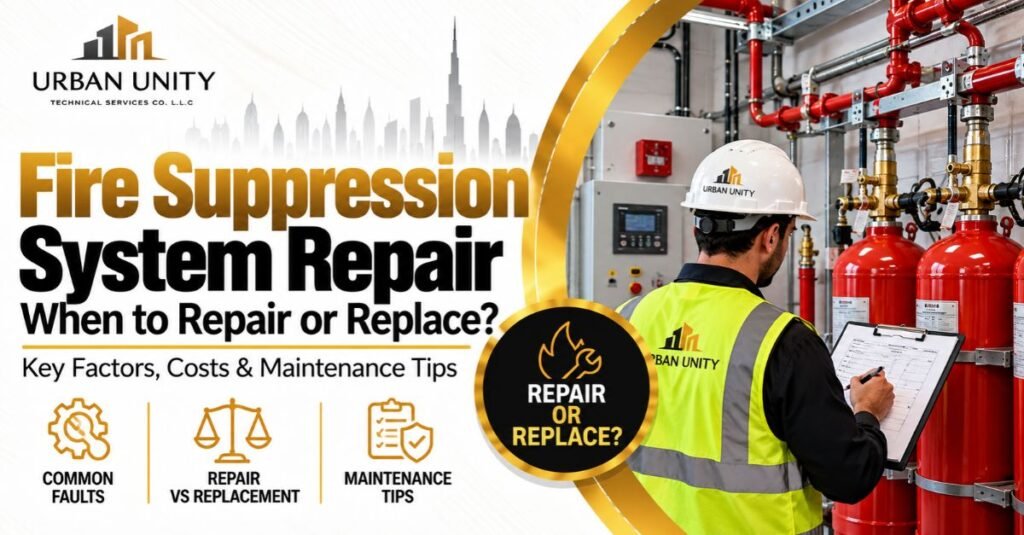
Fire Suppression System Repair: Repair or Replace?
A fire suppression system is designed to respond quickly when a fire starts, but like any safety system, its components can wear out, become damaged, develop faults, or become unsuitable after changes to the property. Knowing when to arrange fire suppression system repair — and when replacement is the safer long-term option — can help property owners avoid unexpected failures, repeated maintenance costs, and inspection problems.
This is especially important for restaurants, commercial kitchens, warehouses, industrial facilities, offices, and other properties that depend on reliable commercial fire suppression systems to protect people, equipment, and business operations.
In this guide, we’ll explain the most common signs that a system needs repair, when fire suppression system replacement should be considered, how to compare repair versus replacement costs, and why regular fire suppression system maintenance is essential for keeping the system reliable over time.
Table of Contents
ToggleSigns Your Fire Suppression System Needs Repair
A reliable system should remain ready to activate when needed. When faults start appearing, delaying fire suppression system repair can increase the risk of system failure, repeated inspection issues, and more expensive damage later.
Common warning signs include:
- Faults or warning indicators on the control panel
- Leaking pipes, valves, or suppression agent containers
- Low pressure readings
- Damaged nozzles or discharge components
- Corrosion or visible physical damage
- Failed alarms or system interfaces
- Frequent false activations or fault signals
- Components that no longer reset correctly after testing
- Changes to the kitchen, warehouse, or protected area that affect coverage
For a kitchen fire suppression system repair, changes to cooking appliances, hood layouts, fryers, grills, or gas equipment are especially important. The original suppression coverage may no longer match the actual risk if the kitchen layout has changed.
A professional fire suppression system inspection should identify whether the fault can be repaired safely or whether individual components need replacement.
Regular fire suppression system maintenance also helps catch small issues before they become major failures.
When Repair Is No Longer Enough
In some cases, fire suppression system repair is not the best long-term solution. If the system is outdated, repeatedly failing, or no longer suitable for the protected area, replacement may be safer and more cost-effective.
You should consider fire suppression system replacement when:
- The same faults keep returning after repair
- Replacement parts are difficult or impossible to source
- The system no longer matches the current kitchen or facility layout
- Corrosion or physical damage affects major components
- Pressure problems cannot be corrected reliably
- The system has failed multiple inspections
- The manufacturer no longer supports the equipment
- The cost of repeated repairs is approaching the cost of replacement
This is especially important for restaurants and commercial kitchens. If cooking equipment, hoods, or appliance positions have changed, the original kitchen fire suppression system may no longer provide proper coverage.
For warehouses or industrial facilities, a change in storage layout, process, or fire risk can also make an older commercial fire suppression system unsuitable.
A qualified fire fighting company in Dubai should assess the system before recommending replacement. The decision should be based on safety, reliability, compliance, parts availability, and long-term maintenance cost — not age alone.
Key Point: If repairs are frequent, parts are obsolete, or the protected area has changed, replacement may be the better long-term option.
Repair vs Replacement: How to Decide
The choice between fire suppression system repair and full replacement should depend on the condition of the system, the seriousness of the fault, parts availability, and long-term reliability.
| Factor | Repair May Be Better | Replacement May Be Better |
|---|---|---|
| Type of fault | One isolated component has failed | Multiple components are failing |
| Spare parts | Replacement parts are readily available | Parts are obsolete or difficult to source |
| System reliability | The system is generally reliable | Faults keep returning after repairs |
| Protected area | The kitchen or facility layout has not changed | The layout, equipment, or fire risk has changed |
| Pressure & controls | Pressure, alarms, or interfaces can be restored reliably | Major performance problems continue after repair |
| Maintenance history | The system has been regularly maintained | Maintenance history is poor or faults are recurring |
| Cost | Repair cost is reasonable compared with replacement | Repeated repairs are becoming expensive |
| Future use | The system still suits current operational needs | The system no longer meets the facility’s needs |
A professional fire suppression system inspection should be completed before making the final decision.
For example, a restaurant with one damaged nozzle may only need a targeted kitchen fire suppression system repair. However, if the cooking line has been completely redesigned and the existing system no longer covers the new appliances, replacement or redesign may be more appropriate.
The same principle applies to larger commercial fire suppression systems. The goal is to choose the option that delivers the safest and most reliable long-term result — not simply the cheapest short-term fix.
Regular fire suppression system maintenance can help reduce unexpected failures, extend component life, and identify problems before they turn into costly repairs or full replacement.
A proper maintenance programme should include:
- Checking pressure levels
- Inspecting nozzles and discharge points
- Testing control panels and alarm interfaces
- Checking valves and cylinders
- Looking for corrosion or leaks
- Confirming that protected areas still match the original system design
- Reviewing maintenance and inspection records
- Replacing worn or damaged components early
For restaurants, regular kitchen fire suppression system service is especially important because grease, heat, and changes to cooking equipment can affect system performance over time.
For larger commercial properties, scheduled fire suppression system inspection and maintenance can also help prevent repeated fire protection system repair and reduce the chance that a small fault becomes a major system issue.
If a system begins showing recurring faults, low pressure, or ageing components, early maintenance can also help determine whether repair is still practical or whether fire suppression system replacement should be considered.
Conclusion
Knowing when to choose fire suppression system repair and when to replace the system can help property owners avoid repeated faults, unnecessary costs, and unreliable fire protection.
The key takeaway is to look at the complete condition of the system rather than one fault alone. If the equipment is still supported, the protected area has not changed, and the issue is isolated, repair may be the most practical option. But when faults keep returning, parts become obsolete, or the system no longer matches the actual fire risk, fire suppression system replacement may provide better long-term value.
Regular fire suppression system maintenance and inspection can also extend system life and help identify problems before they become major failures.
Urban Unity provides fire suppression system repair, inspection, maintenance, rectification, replacement support, and fire protection services across the UAE.
Whether you have a kitchen suppression system, commercial fire suppression system, or recurring fire protection faults, our team can inspect the system and recommend the most suitable next step.