
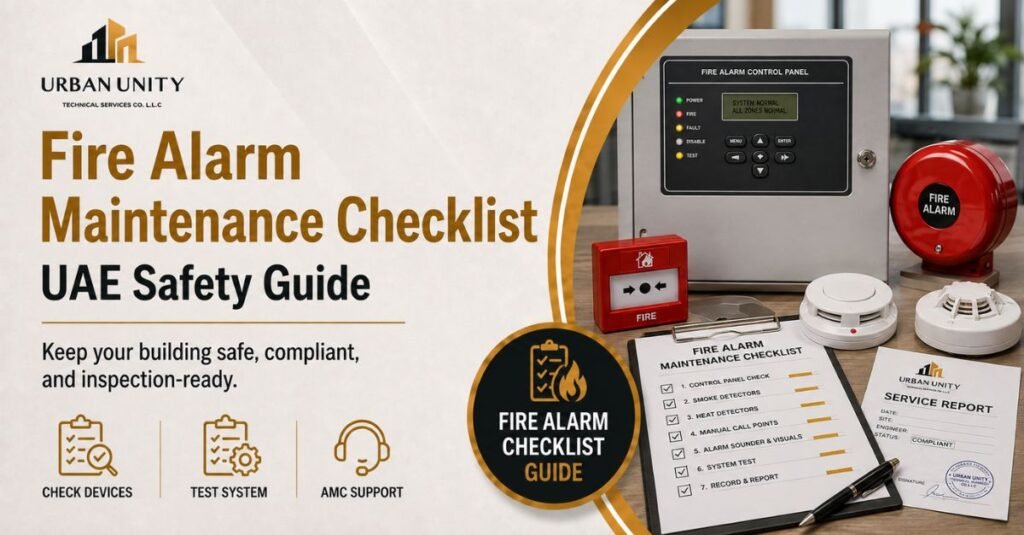
Fire Alarm Maintenance Checklist: UAE Safety Guide
Fire alarm maintenance is a critical part of keeping UAE buildings safe, compliant, and ready for inspection. A fire alarm system should not only be installed correctly; it must also be tested, cleaned, checked, and serviced regularly to make sure the panel, detectors, manual call points, sounders, strobes, batteries, wiring, loops, and zones work properly when needed.
This guide is especially useful for building owners, facility managers, business tenants, contractors, and property managers responsible for offices, warehouses, restaurants, retail shops, clinics, salons, factories, schools, and commercial buildings across the UAE.
In this post, we’ll explain Fire Alarm Maintenance Checklist: UAE Safety Guide, show why regular fire alarm system maintenance matters for business safety and Civil Defence readiness, and provide a practical checklist you can use to understand what should be inspected during a fire alarm AMC or maintenance visit.
What is Fire Alarm Maintenance?
Fire alarm maintenance is the regular inspection, testing, cleaning, and servicing of a fire alarm system to confirm that the control panel, detectors, batteries, manual call points, sounders, strobes, wiring, loops, and zones work correctly. It helps UAE buildings reduce faults, prevent false alarms, support inspection readiness, and improve safety.
In simple terms, fire alarm maintenance keeps your system reliable after installation. A fire alarm system can develop faults because of dust, humidity, weak batteries, damaged wiring, old detectors, renovation work, or poor previous maintenance. If these issues are not checked early, the system may show faults, create repeated false alarms, or fail to respond properly during an emergency.
For commercial buildings in the UAE, regular maintenance is especially important because offices, warehouses, restaurants, clinics, retail shops, salons, factories, and managed residential buildings must protect people, property, and daily business operations.
A proper fire alarm maintenance checklist usually includes checking the fire alarm control panel, testing smoke detectors and heat detectors, inspecting manual call points, checking sounders and strobes, testing backup batteries, checking wiring and device communication, reviewing fault history, and preparing a service report.
Many businesses manage this through a fire alarm AMC, or annual maintenance contract, to make sure inspections and servicing are done on a planned schedule instead of waiting for faults or emergency repairs.
Fire Alarm Maintenance Checklist for UAE Buildings
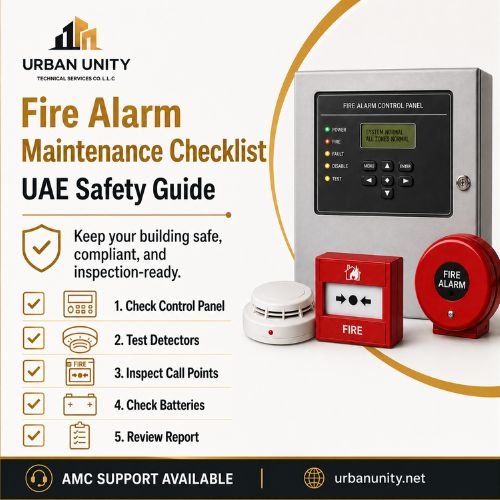
A proper fire alarm maintenance checklist helps building owners and facility managers understand what should be checked during a maintenance visit. While the exact checklist may vary depending on the building type and fire alarm system, these are the key items that should not be missed.
1. Fire Alarm Control Panel Check
The technician should inspect the fire alarm control panel for fault messages, warning lights, alarm history, power status, communication errors, and system settings. The panel is the main control point of the system, so any fire alarm panel fault should be checked carefully.
2. Smoke Detector and Heat Detector Testing
Smoke detectors and heat detectors should be tested to confirm they are connected, responsive, clean, and installed in the correct location. Dirty, damaged, covered, or expired detectors can cause false alarms or fail to detect danger during an emergency.
3. Manual Call Point Inspection
Manual call points should be visible, accessible, undamaged, and working properly. They should not be blocked by furniture, storage items, decorations, or renovation materials, especially in offices, warehouses, restaurants, shops, clinics, and commercial buildings.
4. Sounder and Strobe Testing
Sounders, bells, and strobe lights should be tested to make sure people inside the building can hear and see the alarm clearly. This is especially important in noisy areas, warehouses, kitchens, basements, corridors, and large commercial spaces.
5. Backup Battery Check
Backup batteries should be inspected for charging status, age, condition, and performance. A fire alarm battery fault can affect the system during a power failure, so weak or expired batteries should be replaced before they create a serious risk.
6. Wiring, Loop, and Zone Inspection
The technician should check wiring, cable connections, fire alarm loops, and zones for loose connections, damage, short circuits, open circuits, or communication faults. Loop faults and zone faults are common issues after fit-out, renovation, ceiling work, or MEP modifications.
7. Fault History Review
The fire alarm system history should be reviewed to identify repeated faults, false alarm causes, previous repairs, and unresolved issues. This helps the fire alarm maintenance contractor understand whether the system needs cleaning, repair, replacement, or better AMC follow-up.
8. Device Cleaning and Physical Condition Check
Fire alarm devices should be checked for dust, paint, humidity, insects, physical damage, or obstruction. Detectors, call points, sounders, strobes, and panels should remain clean, visible, and accessible at all times.
9. Service Report and Recommendations
After the visit, the contractor should provide a clear fire alarm maintenance report. The report should include what was tested, what faults were found, what repairs were completed, and what recommendations are needed for future safety and inspection readiness.
10. AMC Follow-Up Plan
For commercial buildings, a fire alarm AMC helps keep maintenance organized throughout the year. It supports regular testing, quick troubleshooting, proper documentation, and better preparation before inspections, renewals, tenant handovers, or authority visits.
A checklist like this makes fire alarm maintenance easier to manage and helps ensure that important system components are not ignored.
Why is Fire Alarm Maintenance Important?
Fire alarm maintenance is important because a fire alarm system must work correctly before, during, and after an emergency. In commercial buildings, a small fault in the panel, detector, battery, wiring, loop, or zone can affect safety, delay response, create false alarms, or cause problems during inspections.
In the UAE, this is especially important because commercial buildings and residential apartments are monitored through Hassantuk, the Intelligent Command and Control solution launched by UAE Civil Defence to monitor and detect fire and smoke alarms. Hassantuk also states that fire and life safety alarms from connected buildings are received 365 days a year, along with maintenance alarms generated from building systems.
For building owners, facility managers, and business tenants, regular fire alarm maintenance matters for several reasons:
1. It Helps Protect People and Property
A maintained fire alarm system gives early warning when smoke, heat, or fire risk is detected. This helps people evacuate faster and reduces the risk of injury, property damage, and business loss.
2. It Reduces False Alarms and System Faults
Dusty detectors, weak batteries, damaged cables, humidity, poor installation, or old devices can cause repeated faults or false alarms. Regular maintenance helps identify these problems before they disturb daily operations.
3. It Supports Civil Defence Readiness
In Dubai, Law No. 4 of 2025 states that owners of buildings, establishments, and facilities must carry out regular maintenance of fire prevention systems and comply with preventive safety requirements. This makes fire alarm maintenance an important part of building responsibility, not only a technical service.
4. It Helps Avoid Expensive Emergency Repairs
A small issue found during a scheduled fire alarm inspection is usually easier and cheaper to fix than a major failure before renewal, inspection, tenant handover, or business opening.
5. It Improves Business Continuity
For offices, warehouses, restaurants, shops, clinics, salons, factories, and commercial buildings, repeated fire alarm faults can interrupt work, worry tenants, disturb customers, and affect trust in the building management. A planned fire alarm AMC helps keep the system checked, documented, and ready.
In short, fire alarm maintenance helps UAE businesses protect people, reduce faults, avoid last-minute problems, and keep their buildings safer and more inspection-ready.
Tips and Reminders for Fire Alarm Maintenance
Fire alarm maintenance can feel technical, especially for business owners or facility managers who are not fire safety specialists. The key is to focus on regular checks, proper documentation, and fast action when faults appear.
1. Do Not Wait for the Panel to Show a Fault
Fire alarm maintenance should be planned before problems happen. Waiting until the fire alarm panel shows a fault can lead to urgent repairs, inspection delays, or business disruption.
2. Keep a Simple Maintenance Checklist
Make sure every visit includes the main system parts: fire alarm control panel, smoke detectors, heat detectors, manual call points, sounders, strobes, backup batteries, wiring, loops, zones, and fault history.
3. Save All Service Reports
After each fire alarm inspection or AMC visit, keep a copy of the service report. These records help with building management, tenant communication, Civil Defence readiness, and future troubleshooting.
4. Train Staff to Report Warning Signs
Your team should report beeping alarms, blinking fault lights, damaged detectors, covered devices, or repeated false alarms. Early reporting helps prevent small issues from becoming serious fire alarm system faults.
5. Work With a Qualified Fire Alarm Contractor
Choose a fire alarm maintenance contractor who understands commercial buildings in the UAE. Offices, warehouses, restaurants, clinics, shops, factories, and residential buildings all have different risks and maintenance needs.
Closing
Fire alarm maintenance is not something UAE building owners should leave until a fault appears or an inspection date is near. A well-maintained fire alarm system helps protect people, reduce false alarms, prevent emergency breakdowns, and keep commercial buildings safer and more inspection-ready.
The key takeaway is simple: use a clear fire alarm maintenance checklist and make sure every important part of the system is checked, including the fire alarm control panel, smoke detectors, heat detectors, manual call points, sounders, strobes, backup batteries, wiring, loops, zones, and service reports.
Whether you manage an office, warehouse, restaurant, clinic, retail shop, salon, factory, school, or commercial building, regular fire alarm system maintenance can help you avoid last-minute problems and improve safety for everyone inside the property.
You can also explore our related resources on fire alarm troubleshooting, commercial fire alarm maintenance, fire system maintenance, DCD approval, fire fighting systems, and MEP services in the UAE.
Call-to-Action
Need fire alarm maintenance or a fire alarm AMC for your building in Dubai, Sharjah, or anywhere in the UAE?
Urban Unity provides fire alarm inspection, testing, troubleshooting, repair, AMC support, and commercial fire alarm maintenance for UAE buildings. Our team can help you check your system, identify faults, prepare maintenance reports, and keep your fire alarm system ready for daily operation and inspection.
Call : 0547814366
WhatsApp link: https://wa.me/971547814366
Email: firas@urbanunity.net