
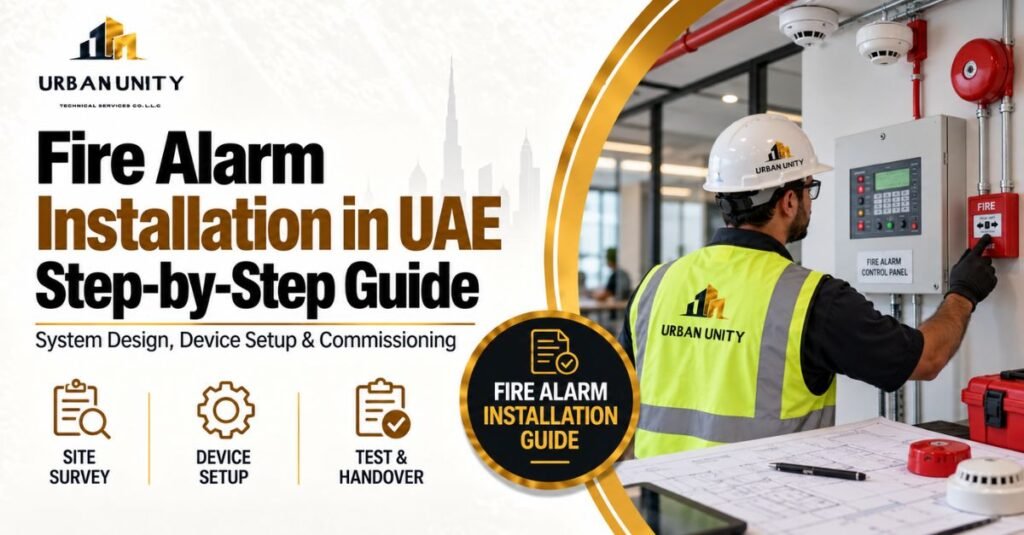
Fire alarm installation is one of the most important steps in making a UAE building safe, compliant, and ready for daily operation. A fire alarm system is not just a panel on the wall; it includes smoke detectors, heat detectors, manual call points, sounders, strobes, wiring, control panels, testing, commissioning, and ongoing maintenance.
This guide is especially useful for building owners, facility managers, contractors, consultants, and business tenants planning fire alarm installation in offices, warehouses, restaurants, retail shops, clinics, salons, schools, factories, villas, and commercial buildings across the UAE.
Choosing the right fire alarm contractor and following a proper fire alarm installation process can help reduce future faults, false alarms, inspection delays, and expensive rework. It also supports Civil Defence compliance and makes future fire alarm maintenance or AMC easier to manage.
In this post, we’ll explain Fire Alarm Installation in UAE: Step-by-Step Guide, cover the key devices involved, show what happens during installation and testing, and explain what you should check before hiring a fire alarm installation company.
Table of Contents
ToggleWhat is Fire Alarm Installation?
Fire alarm installation is the process of designing, installing, wiring, testing, and commissioning a fire alarm system in a building. It includes fire alarm control panels, smoke detectors, heat detectors, manual call points, sounders, strobes, cables, and related devices to detect fire risks and alert people quickly during an emergency.
A proper fire alarm installation is not only about placing devices on walls and ceilings. It starts with checking the building layout, identifying fire-risk areas, selecting the right fire alarm devices, planning cable routes, installing the fire alarm control panel, testing each device, and making sure the complete system works correctly.
For UAE buildings, this process is especially important because offices, warehouses, restaurants, clinics, retail shops, factories, villas, schools, and commercial buildings all have different fire safety needs. A small shop may need a simpler fire alarm system, while a warehouse, restaurant, or multi-floor commercial building may require more devices, zoning, addressable fire alarm system design, and detailed testing.
After installation, the system should be tested, commissioned, documented, and maintained regularly through fire alarm maintenance or a fire alarm AMC. This helps reduce faults, false alarms, inspection delays, and future repair costs.
Why Fire Alarm Installation Matters in UAE
Fire alarm installation matters in the UAE because it directly affects life safety, building compliance, business continuity, and emergency response. A properly installed fire alarm system helps detect smoke, heat, or fire risk early, alert people inside the building, and support faster action before the situation becomes serious.
This is especially important for commercial buildings such as offices, warehouses, restaurants, clinics, retail shops, salons, factories, schools, villas, and residential buildings. Each property has different fire risks, so the fire alarm installation process must match the building layout, occupancy, device locations, wiring requirements, and Civil Defence readiness.
The UAE Government explains that commercial buildings and residential apartments are monitored through Hassantuk to detect fire and smoke alarms. Hassantuk’s official overview also states that fire and life safety alarms from connected buildings are received 365 days a year, along with maintenance alarms generated from building systems.
A poor installation can lead to false alarms, missed detection, repeated fire alarm faults, failed inspections, expensive rework, and difficult maintenance. On the other hand, a properly designed and tested fire alarm system helps the building owner, facility manager, or tenant reduce risk, improve safety, and keep the property inspection-ready.
For this reason, fire alarm installation should always be handled as a complete process: site survey, system design, device selection, wiring, installation, testing, commissioning, documentation, and future fire alarm maintenance or AMC support.
Fire Alarm Installation Process: Step-by-Step
A proper fire alarm installation should follow a clear process from the first site survey to final testing and handover. This helps avoid wrong device placement, wiring issues, false alarms, inspection delays, and future maintenance problems.
1. Site Survey and Building Assessment
The process starts with a site survey. The fire alarm contractor checks the building layout, room usage, ceiling type, exit routes, high-risk areas, electrical rooms, storage areas, kitchens, corridors, and existing fire safety systems.
This step helps decide what type of fire alarm system is suitable for the property and where devices should be installed.
2. Fire Alarm System Design
After the survey, the contractor prepares the fire alarm system design. This includes the location of the fire alarm control panel, smoke detectors, heat detectors, manual call points, sounders, strobes, wiring routes, zones, and loops.
For larger buildings, the contractor may recommend an addressable fire alarm system. For smaller or simpler spaces, a conventional fire alarm system may be enough.
3. Device Selection
The next step is choosing the right fire alarm devices. This may include:
-
Fire alarm control panel
-
Smoke detectors
-
Heat detectors
-
Manual call points
-
Sounders and strobes
-
Interface modules
-
Backup batteries
-
Fire-rated cables
-
Alarm bells or sirens
The device selection depends on the building type, risk level, layout, and UAE fire safety requirements.
4. Fire Alarm Wiring and Installation
Once the design and devices are approved, the technician starts the fire alarm wiring and installation work. This includes cable pulling, conduit work, device mounting, panel installation, and connection of all fire alarm devices.
Good installation is important because poor wiring or loose connections can create future fire alarm faults, loop faults, zone faults, or false alarms.
5. Testing Each Device
After installation, every device should be tested. The technician checks smoke detectors, heat detectors, manual call points, sounders, strobes, batteries, panel signals, and system communication.
This step confirms that the fire alarm system can detect a risk and alert people correctly.
6. Fire Alarm Commissioning
Fire alarm commissioning is the final technical check before handover. The contractor verifies that the full system works as designed, the panel receives correct signals, devices respond properly, and alarms activate in the correct areas.
Commissioning is very important because it confirms that the installation is ready for operation, inspection, and future maintenance.
7. Documentation and Handover
After testing and commissioning, the contractor should provide the required documents, drawings, device details, test reports, and maintenance recommendations.
These documents help the building owner, facility manager, or tenant manage future fire alarm inspection, troubleshooting, AMC, and Civil Defence readiness.
8. Maintenance After Installation
Fire alarm installation does not end after handover. The system should be maintained regularly through fire alarm maintenance or a fire alarm AMC. Regular checks help reduce false alarms, battery faults, detector issues, and emergency repair costs.
A good installation process should always end with a clear maintenance plan so the system remains safe, reliable, and inspection-ready.
Fire Alarm Devices Installed in a System
A complete fire alarm installation includes different devices that work together to detect danger, alert people, and send signals to the fire alarm control panel. The exact devices depend on the building type, layout, risk level, and fire alarm system design.
1. Fire Alarm Control Panel
The fire alarm control panel is the main control point of the system. It receives signals from connected devices, shows alarms or faults, and helps the technician identify what is happening in the building.
2. Smoke Detectors
Smoke detector installation is important in areas where smoke may be the first sign of fire. Smoke detectors are commonly installed in offices, corridors, shops, clinics, schools, and commercial spaces.
3. Heat Detectors
Heat detector installation is often used in areas where smoke detectors may cause false alarms, such as kitchens, parking areas, mechanical rooms, or dusty spaces. They detect heat changes instead of smoke.
4. Manual Call Points
A manual call point allows people inside the building to manually activate the fire alarm system during an emergency. These should be visible, accessible, and installed in the right locations near exits or escape routes.
5. Sounders and Strobes
Sounders and strobes alert people when the fire alarm system activates. Sounders produce audible warning signals, while strobes provide visual alerts, which are especially useful in noisy areas or large commercial spaces.
6. Fire Alarm Cables and Wiring
Proper fire alarm wiring is essential for reliable system performance. Poor wiring, loose connections, or wrong cable routes can cause fire alarm faults, false alarms, loop faults, or system failure.
7. Backup Batteries
Backup batteries keep the fire alarm system operating during a power failure. During installation, batteries should be connected, tested, and checked to make sure the system can continue working when main power is interrupted.
8. Modules and Interfaces
Some fire alarm systems include modules or interfaces connected to other building systems, such as elevators, HVAC, access control, fire fighting systems, or monitoring systems. These help different safety systems work together during an emergency.
Each device has a specific role. A good fire alarm contractor should not only install the devices, but also test them, label them correctly, prepare documentation, and explain how they should be maintained after handover.
What Affects Fire Alarm Installation Cost?
The cost of fire alarm installation in the UAE depends on the building size, system type, number of devices, wiring requirements, and project complexity. A small shop or office will not have the same installation cost as a warehouse, restaurant, clinic, school, factory, or multi-floor commercial building.
Larger buildings usually need more smoke detectors, heat detectors, manual call points, sounders, strobes, cables, and fire alarm zones or loops. A building with many rooms, corridors, storage areas, or floors will normally require more planning and installation work.
The system type affects the cost. An addressable fire alarm system usually costs more because it gives device-level information and needs more advanced programming. A conventional fire alarm system is often more affordable for smaller or simpler buildings.
The total number of devices directly affects the price. This includes the fire alarm control panel, detectors, manual call points, sounders, strobes, modules, backup batteries, and other connected devices.
Fire alarm wiring can be simple or complex depending on the ceiling type, cable route, wall access, distance between devices, and whether the project is new construction, renovation, or fit-out. Difficult access can increase installation time and cost.
A proper fire alarm installation should include testing and commissioning. This confirms that the panel, detectors, call points, sounders, strobes, batteries, loops, zones, and communication signals are working correctly before handover.
Some projects may need drawings, test reports, device schedules, maintenance recommendations, and support for Civil Defence readiness. These steps are important because they help reduce inspection delays and future rework.
The lowest installation quote is not always the best option. You should also consider future fire alarm maintenance, AMC support, troubleshooting, spare parts, and repair service. A poorly installed system can create repeated faults and higher maintenance costs later.
The best way to estimate the cost is to arrange a site survey. A qualified fire alarm contractor can check your building, count the required devices, review wiring needs, and recommend the right system before giving a quotation.
Common Mistakes to Avoid During Fire Alarm Installation
A proper fire alarm installation should protect the building and make future maintenance easier. However, mistakes during installation can lead to false alarms, system faults, inspection delays, and expensive rework. Here are some common mistakes UAE building owners should avoid.
A low quotation may look attractive, but poor installation can create long-term problems. Wrong wiring, poor device placement, weak testing, or missing documentation can cause repeated fire alarm faults and higher repair costs later.
Not every building needs the same system. A small shop may be suitable for a conventional fire alarm system, while a warehouse, clinic, restaurant, school, or large commercial building may need an addressable fire alarm system. The choice should depend on building size, risk level, layout, and future maintenance needs.
Smoke detectors and heat detectors must be installed in the right locations. Poor placement near AC airflow, steam, dust, cooking smoke, or blocked areas can cause false alarms or reduce detection performance.
Fire alarm wiring should be planned carefully. Loose connections, wrong cable routes, poor conduit work, or damaged cables can lead to loop faults, zone faults, communication errors, and fire alarm panel faults after handover.
A fire alarm system should never be handed over without proper testing. The contractor should test the fire alarm control panel, smoke detectors, heat detectors, manual call points, sounders, strobes, batteries, wiring, loops, and zones before the system is considered ready.
Fire alarm installation should always include future maintenance planning. Without fire alarm maintenance or a fire alarm AMC, small faults can become urgent problems. A good contractor should explain how the system will be inspected, serviced, and maintained after installation.
Drawings, device schedules, test reports, commissioning records, and service recommendations are important for facility managers, tenants, contractors, and Civil Defence readiness. Missing documents can make future troubleshooting and inspection preparation harder.
Avoiding these mistakes helps make your fire alarm system safer, more reliable, easier to maintain, and better prepared for inspections.
Fire alarm installation does not end when the devices are fixed and the system is handed over. After installation, the fire alarm system must be checked, tested, and maintained regularly to stay reliable and ready for daily operation.
This is where fire alarm maintenance and fire alarm AMC become important. Even a properly installed system can develop problems over time because of dust, humidity, weak batteries, damaged wiring, renovation work, tenant changes, or lack of regular inspection.
After handover, building owners and facility managers should make sure the contractor provides clear documentation, test reports, device details, panel information, and maintenance recommendations. These records help with future fire alarm inspection, troubleshooting, repair, and Civil Defence readiness.
A planned maintenance routine should include checking the fire alarm control panel, smoke detectors, heat detectors, manual call points, sounders, strobes, backup batteries, wiring, loops, zones, and fault history. This helps reduce false alarms, avoid emergency repairs, and keep the system working correctly.
For UAE commercial buildings, the safest approach is to choose a contractor who can support both fire alarm installation and long-term maintenance. This gives you one team that understands your system from design and installation to testing, AMC, and future upgrades.
Closing
Fire alarm installation is not only about fixing devices on walls and ceilings. It is a complete safety process that includes site survey, system design, device selection, wiring, testing, commissioning, documentation, and future maintenance.
For UAE buildings, a properly installed fire alarm system helps protect people, reduce false alarms, support Civil Defence readiness, and make future fire alarm maintenance easier. Whether you manage an office, warehouse, restaurant, clinic, shop, school, villa, factory, or commercial building, the right system should match your building layout, risk areas, budget, and long-term maintenance needs.
The key takeaway is simple: do not choose a fire alarm contractor based only on the cheapest quote. Choose a team that understands fire alarm installation, testing, commissioning, maintenance, AMC support, and UAE building requirements.
Urban Unity provides fire alarm installation, smoke detector installation, heat detector installation, manual call point installation, fire alarm control panel setup, fire alarm testing, commissioning, maintenance, and AMC support for UAE buildings.
Our team can inspect your site, recommend the right fire alarm system, install the required devices, test the system, and support you after handover with maintenance and troubleshooting.