
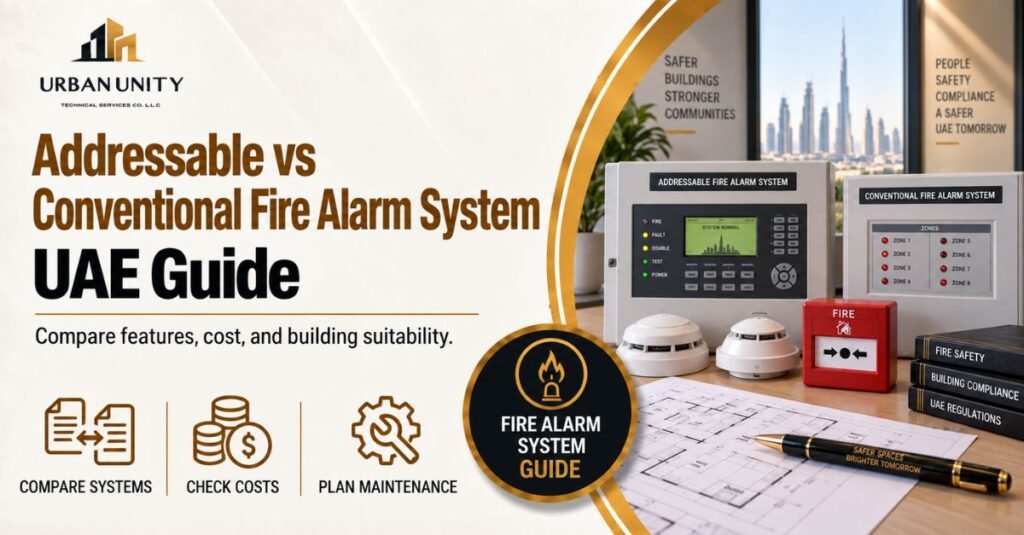
Addressable vs Conventional Fire Alarm System: UAE Guide
Choosing between an addressable vs conventional fire alarm system is one of the most important decisions before installing or upgrading fire safety systems in a UAE building. The right choice can affect system performance, fault detection, maintenance cost, Civil Defence readiness, and how quickly your team can identify the location of a fire alarm, smoke detector fault, loop fault, or zone fault.
This topic is especially important for building owners, facility managers, contractors, consultants, and business tenants managing offices, warehouses, restaurants, clinics, retail shops, factories, schools, residential buildings, and commercial properties across the UAE.
An addressable fire alarm system gives more detailed device-level information, while a conventional fire alarm system divides the building into zones. Both systems can be useful, but the best option depends on your building size, layout, risk level, budget, maintenance needs, and fire alarm installation requirements.
In this guide, we’ll explain the difference between addressable and conventional fire alarm systems, compare their advantages, and help you understand which system may be better for your UAE building.
What is an Addressable vs Conventional Fire Alarm System?
An addressable vs conventional fire alarm system comparison explains the difference between two common types of fire alarm systems used in UAE buildings. An addressable system identifies the exact device or location of an alarm or fault, while a conventional system divides the building into zones to show the general area of the issue.
Both systems are designed to detect fire risks and alert people inside the building, but they work in different ways. The right choice depends on your building size, layout, budget, risk level, and maintenance needs.
An addressable fire alarm system is usually better for larger or more complex buildings because each smoke detector, heat detector, manual call point, sounder, or module has its own address. This helps the fire alarm control panel show exactly where the alarm, fault, or device issue is located.
A conventional fire alarm system is often used in smaller or simpler buildings. Instead of showing the exact device, it divides the property into fire alarm zones. If there is an alarm or fault, the panel shows the affected zone, and the technician or facility team must inspect that area to find the exact device.
For UAE commercial buildings, this decision is important because the fire alarm system affects installation cost, troubleshooting speed, fire alarm maintenance, future expansion, and Civil Defence compliance.
What is an Addressable Fire Alarm System?
An addressable fire alarm system is a smart fire alarm system where each device has its own unique address. This means the fire alarm control panel can identify the exact smoke detector, heat detector, manual call point, module, or device that triggered an alarm or fault.
For example, instead of only showing “Zone 2 Fault,” an addressable system can show a more specific location such as a detector in a corridor, office, warehouse area, kitchen, electrical room, or storage space. This makes it easier for the facility team or fire alarm technician to find the issue quickly.
Addressable systems are commonly used in larger or more complex UAE buildings such as offices, warehouses, schools, clinics, restaurants, factories, hotels, malls, and commercial towers. They are useful when a building has many rooms, floors, tenants, devices, or high-risk areas.
The main advantage of an addressable fire alarm system is better accuracy. It helps with faster emergency response, easier fire alarm troubleshooting, better system monitoring, and more efficient fire alarm maintenance. It can also support future expansion if the building layout changes or more devices need to be added.
However, an addressable system usually costs more than a conventional fire alarm system because the devices, panel, programming, testing, and installation are more advanced. For many commercial buildings, the higher cost is worth it because the system gives better control, clearer fault information, and improved maintenance support.
What is a Conventional Fire Alarm System?
A conventional fire alarm system is a fire alarm system that divides a building into zones. Each zone covers a specific area, such as a floor, corridor, office section, warehouse area, shop, kitchen, or storage room. When an alarm or fault happens, the fire alarm control panel shows the affected zone, not the exact device.
For example, if a smoke detector activates in Zone 1, the panel may show “Zone 1 Alarm.” The facility team or fire alarm technician then needs to inspect that zone to find the exact detector, manual call point, or device that caused the alarm.
Conventional systems are often used in smaller UAE buildings or simple commercial spaces where the number of devices is limited. They can be suitable for small offices, shops, villas, small warehouses, clinics, salons, and low-complexity spaces where zoning is enough to identify the general location of a fire alarm issue.
The main advantage of a conventional fire alarm system is that it is usually more affordable and easier to install than an addressable fire alarm system. It can be a practical choice when the building layout is simple and the budget is limited.
However, conventional systems provide less detailed information. They may take more time to troubleshoot because the panel only shows the affected zone. If the building is large, has many rooms, or contains multiple tenants, an addressable system may be a better option for faster fault detection, easier fire alarm maintenance, and better Civil Defence readiness.
Addressable vs Conventional Fire Alarm System Comparison Table
| Comparison Point | Addressable Fire Alarm System | Conventional Fire Alarm System |
|---|---|---|
| How it identifies alarms | Shows the exact device or location that triggered the alarm or fault. | Shows the affected zone only, not the exact device. |
| Best for | Large, complex, or multi-area buildings. | Small or simple buildings with fewer devices. |
| Common UAE use cases | Warehouses, hotels, malls, schools, clinics, factories, commercial towers, and large offices. | Small offices, shops, villas, salons, small clinics, and simple commercial spaces. |
| Fire alarm control panel | More advanced panel with detailed device information and programming. | Simpler panel that displays alarms and faults by zone. |
| Fault detection | Easier to find device faults, loop faults, detector faults, and communication issues. | Faults are shown by zone, so the technician must inspect the area manually. |
| Troubleshooting speed | Faster because the exact device can be identified. | Slower because the affected zone must be checked to find the issue. |
| Installation cost | Usually higher due to advanced devices, programming, and setup. | Usually more affordable for smaller buildings. |
| Maintenance | Easier to manage in large buildings because faults are more specific. | Can be simple to maintain in small buildings, but harder in larger spaces. |
| Future expansion | Better for future expansion, renovation, and additional devices. | More limited if the building expands or needs more detailed monitoring. |
| Accuracy | High accuracy and better system visibility. | Basic accuracy based on zones. |
| Best choice if you need | Better control, faster response, easier troubleshooting, and detailed monitoring. | A cost-effective system for a smaller or simpler property. |
In simple terms, an addressable fire alarm system is usually better when accuracy, fast troubleshooting, and future expansion are important. A conventional fire alarm system can be a practical choice when the building is smaller, the layout is simple, and the budget is more limited.
Decision-Making Checklist: Which System Should You Choose?
Use this simple checklist before choosing between an addressable vs conventional fire alarm system for your UAE building. It can help you understand which option may be more suitable before speaking with a fire alarm contractor.
Choose an Addressable Fire Alarm System If:
- Your building is large, multi-floor, or has many rooms.
- You manage a warehouse, hotel, school, clinic, factory, mall, commercial tower, or large office.
- You need to identify the exact smoke detector, heat detector, manual call point, or device during an alarm or fault.
- You want faster fire alarm troubleshooting and easier fault detection.
- Your building may expand, renovate, or add more fire alarm devices in the future.
- You want better system monitoring and more detailed fire alarm maintenance reports.
- Your property has multiple tenants, high-risk areas, or complex fire alarm zones.
- You prefer long-term control and accuracy over the lowest installation cost.
Choose a Conventional Fire Alarm System If:
- Your building is small, simple, and easy to divide into zones.
- You manage a small office, shop, salon, villa, small clinic, or small warehouse.
- You have fewer fire alarm devices and a simple building layout.
- You only need the fire alarm control panel to show the general zone of the alarm or fault.
- Your budget is limited and you need a cost-effective fire alarm installation.
- Your property does not require advanced monitoring or detailed device-level information.
- Future expansion is unlikely.
- Your maintenance team can easily inspect each zone when a fault appears.
Quick Rule to Remember
In the UAE, fire alarm system selection should support safety, monitoring, maintenance, and Civil Defence readiness. Dubai Civil Defence lists the UAE Fire and Life Safety Code of Practice as a standard reference for contractors, consultants, and concerned bodies to implement Civil Defence safety requirements. The UAE Government also explains that commercial buildings and residential apartments are monitored through Hassantuk to detect fire and smoke alarms. This is why the choice between an addressable and conventional fire alarm system should be based on building size, layout, risk level, and long-term maintenance needs.
If your building is large, complex, multi-tenant, or high-risk, an addressable fire alarm system is usually the better choice. If your building is small, simple, and budget-sensitive, a conventional fire alarm system may be enough.
However, the final decision should always be based on a proper site survey, system design, Civil Defence requirements, and professional fire alarm installation advice.
Cost and Maintenance Factors to Consider
When comparing an addressable vs conventional fire alarm system, the installation price is important, but it should not be the only factor. UAE building owners should also think about long-term maintenance, troubleshooting time, future expansion, spare parts, and how easy it will be to manage the system after installation.
An addressable fire alarm system usually has a higher upfront cost because the panel, devices, programming, testing, and commissioning are more advanced. However, it can save time during maintenance because the fire alarm control panel can show the exact detector, module, manual call point, or device that needs attention.
A conventional fire alarm system is usually more budget-friendly at the beginning. This can make it attractive for small offices, shops, villas, clinics, and simple commercial spaces. But if the building becomes larger or more complex, troubleshooting may take longer because the panel only identifies the affected fire alarm zone.
For maintenance, addressable systems often make fault detection easier, especially in buildings with many devices. Conventional systems can still be maintained properly, but the technician may need to inspect more areas manually when a fault appears.
Before choosing a system, ask your fire alarm contractor about:
- Installation cost
- Maintenance cost
- Fire alarm AMC requirements
- Spare parts availability
- Future expansion options
- Civil Defence compliance
- Troubleshooting and repair support
The best fire alarm system is not always the cheapest one. It is the system that fits your building, supports safe operation, and remains easy to maintain over time.
Best Fire Alarm System by Building Type in the UAE
When choosing between an addressable vs conventional fire alarm system, the building type plays a major role. A small shop does not usually need the same fire alarm design as a large warehouse, hotel, clinic, or commercial tower. The right system should match the property layout, number of devices, risk areas, and future maintenance needs.
Offices
For small offices with a simple layout, a conventional fire alarm system may be suitable. For larger offices, multi-floor offices, or shared business centers, an addressable fire alarm system is usually better because it can identify the exact device or location of an alarm or fault.
Warehouses
Warehouses often need stronger system visibility because they may include storage areas, loading zones, electrical rooms, high ceilings, and larger fire alarm zones. In many cases, an addressable fire alarm system is the better choice for faster fire alarm troubleshooting and easier maintenance.
Restaurants and Commercial Kitchens
Restaurants may have smoke, heat, cooking equipment, exhaust systems, and higher fire-risk areas. The best option depends on the size and layout, but addressable systems can be helpful when the restaurant has multiple areas such as kitchen, dining, storage, and back-of-house spaces.
Clinics and Medical Centers
Clinics need reliable fire alarm detection because they receive patients, staff, and visitors daily. A small clinic may use a conventional system, but larger clinics or medical centers may benefit from addressable fire alarm control panels, detailed fault detection, and better maintenance reporting.
Retail Shops and Salons
Small retail shops and salons may use conventional fire alarm systems if the space is simple and easy to divide into zones. However, if the shop is inside a mall or part of a larger commercial building, the fire alarm design may need to follow the building’s main system and authority requirements.
Factories and Industrial Facilities
Factories and industrial facilities usually need more detailed fire alarm monitoring because they may include machinery, production areas, storage rooms, chemicals, electrical rooms, and staff areas. An addressable fire alarm system is often more practical for these environments.
Villas and Small Buildings
For villas, small offices, and simple standalone buildings, a conventional fire alarm system can be a cost-effective option if it meets the required design and safety needs. The final decision should still be made after a site survey and professional fire alarm installation advice.
In general, larger and more complex UAE buildings usually benefit from addressable systems, while smaller and simpler properties may be suitable for conventional systems. The goal is not only to install a fire alarm system, but to choose one that is safe, compliant, easy to maintain, and suitable for the way the building is used.
Mistakes to Avoid When Choosing a Fire Alarm System
Choosing between an addressable vs conventional fire alarm system should not be based only on price. A wrong decision can lead to poor detection, difficult troubleshooting, higher maintenance costs, and problems during future upgrades or inspections.
1. Choosing Only the Cheapest Option
A lower installation price may look attractive, but it is not always the best long-term choice. If your building is large or complex, a conventional system may become harder to manage, especially when you need fast fault detection or future expansion.
2. Ignoring Building Size and Layout
A small office and a large warehouse do not need the same fire alarm system design. Before choosing, consider the number of rooms, floors, tenants, exits, high-risk areas, storage zones, and the total number of fire alarm devices.
3. Forgetting Future Expansion
If your building may expand, renovate, or add more devices later, an addressable fire alarm system may be more practical. It can support better monitoring and easier changes compared to a basic conventional setup.
4. Not Thinking About Maintenance
Fire alarm maintenance is easier when the system gives clear information. Addressable systems help technicians find the exact device or fault faster, while conventional systems may require more manual inspection inside the affected zone.
5. Skipping Professional Site Survey
The final choice should be based on a proper site survey, not guesswork. A qualified fire alarm contractor can check the building layout, fire alarm zones, detector locations, wiring requirements, panel capacity, and Civil Defence compliance needs before recommending the right system.
The best fire alarm system is the one that fits your building today and remains safe, manageable, and compliant in the future.
Questions to Ask Before Fire Alarm Installation
Before choosing between an addressable vs conventional fire alarm system, it is important to ask the right questions. This helps you avoid wrong system selection, hidden costs, difficult maintenance, and future compliance problems.
1. Which System Is Better for My Building Type?
Ask your fire alarm contractor whether an addressable fire alarm system or conventional fire alarm system is more suitable for your property. The answer should be based on your building size, layout, number of rooms, risk areas, and daily operations.
2. How Many Devices Will the System Need?
The number of smoke detectors, heat detectors, manual call points, sounders, strobes, modules, and control panels can affect the total fire alarm installation cost. A proper site survey helps estimate the right quantity.
3. Will the System Be Easy to Maintain?
Ask how easy it will be to identify faults, replace devices, test the system, and prepare fire alarm maintenance reports. This is especially important for commercial buildings, warehouses, offices, clinics, restaurants, and factories.
4. Can the System Support Future Expansion?
If you may add rooms, partitions, tenants, storage areas, or new equipment later, choose a system that can grow with the building. In many cases, addressable systems are more flexible for future expansion.
5. Does the Design Support Civil Defence Compliance?
Your fire alarm system should be designed, installed, tested, and maintained according to the required safety standards and authority requirements. Ask your contractor how they will support Civil Defence readiness, inspection preparation, and documentation.
6. What Is Included After Installation?
A good fire alarm contractor should explain testing, commissioning, handover documents, maintenance recommendations, AMC options, troubleshooting support, and emergency repair service.
These questions help you choose a fire alarm system that is not only suitable for installation, but also practical for long-term safety, maintenance, and compliance.
NEED HELP CHOOSING?
Choose the Right Fire Alarm System Before You Install
Not sure whether your UAE building needs an addressable fire alarm system or a conventional fire alarm system? Urban Unity can inspect your site, review your building layout, check risk areas, and recommend the safest option for installation, upgrade, or maintenance.
- Site survey before installation
- Addressable or conventional system advice
- Fire alarm installation, AMC, and maintenance support
Book a Site Inspection
Before choosing based only on price, let our team check your building and guide you to the right fire alarm system.
📞 0547814366
✉️ firas@urbanunity.net
🌐 urbanunity.net